
Routine AED maintenance involves more than checking the physical condition of the device or reviewing its built-in self-test status.
During an inspection, service personnel may also need to verify the battery, electrode pads, device information, and other maintenance items. More importantly, test equipment is needed to verify actual AED performance. Inspection and test results must then be properly documented for future reference.
When these tasks are spread across paper forms, test equipment, and separate management systems, the workflow can become fragmented, and the same information may need to be edited or entered multiple times.
This article walks through AED inspection, visual checks, instrument-based testing, maintenance reporting, and data management to show how service teams can build an AED maintenance workflow that fits their own operational needs.
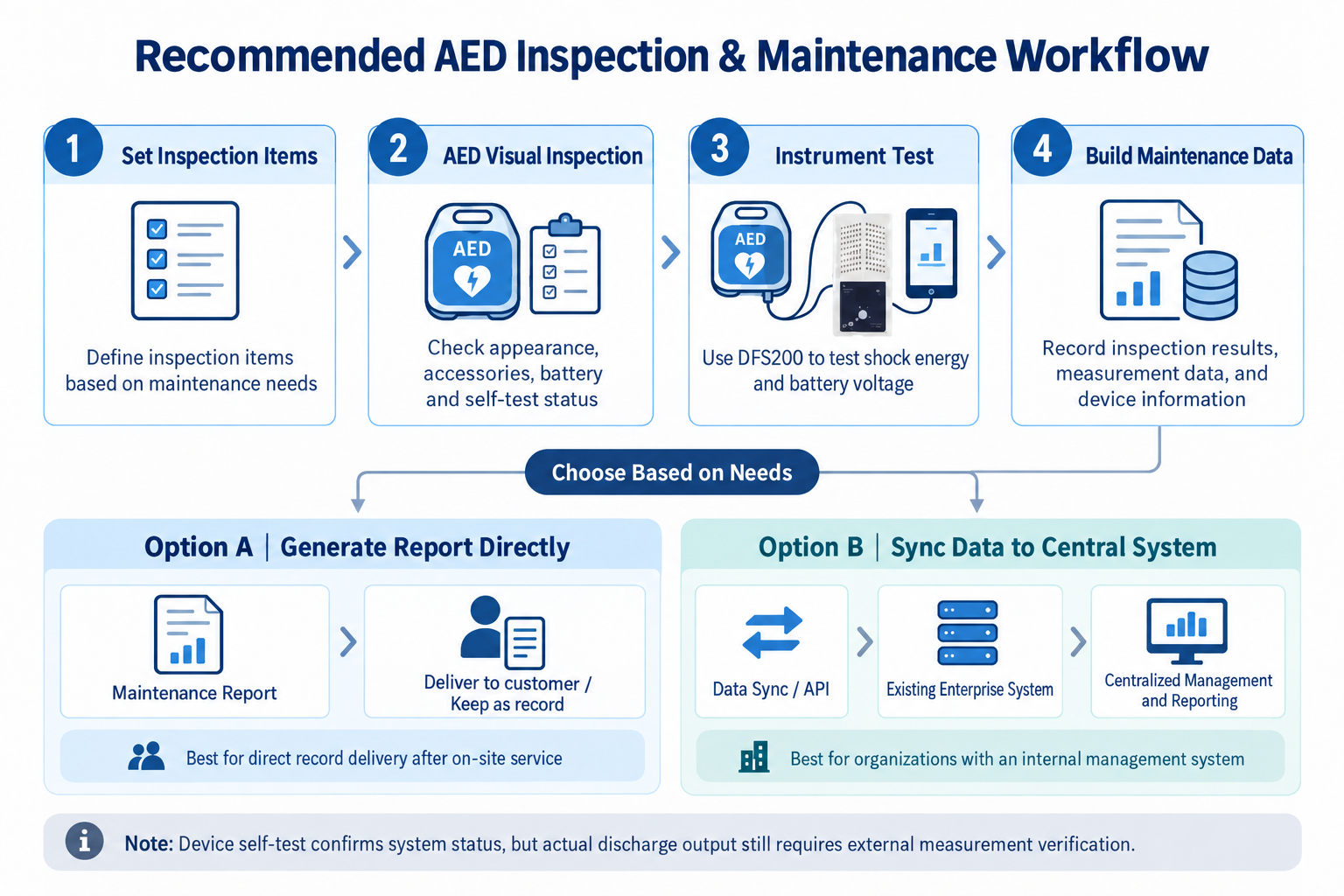
Figure 1. Recommended AED inspection and maintenance workflow. After inspection and instrument testing, maintenance data can either be used to generate a report directly or synchronized with an organization's existing system.
1. Define Inspection Items Based on Your Maintenance Requirements
AED manufacturers, distributors, and service providers often follow different inspection standards.
Some organizations need to check the physical condition of the AED, battery status, and electrode pads. Others may also need to record device IDs, installation locations, asset numbers, customer information, or additional internal management data.
For this reason, an effective AED maintenance workflow should not require every organization to use the same fixed checklist. Instead, it should allow inspection items to be configured around existing standard operating procedures and actual service requirements.
With the DFS200 AED Maintenance & Inspection App (hereafter referred to as the DFS200 App), users can define inspection items according to their own maintenance procedures, allowing field personnel to work through each required item in a consistent sequence.
For teams currently relying on paper forms or multiple disconnected documents, this also means they can begin digitizing their existing workflow without first implementing a complex enterprise management system.
2. Visual Inspection Alone Is Not Enough to Verify Actual AED Performance
An AED's built-in self-test status is typically one of the items checked during routine inspection.
However, a built-in self-test and an external instrument test serve different purposes.
In general, an AED self-test is designed to check elements such as the battery, internal circuitry, and overall system status. A successful self-test does not necessarily confirm the device’s actual discharge output through an external load.
To verify whether an AED delivers the expected shock energy under simulated load conditions, measurement with external test equipment is still required.
A complete AED maintenance process should therefore include:
Visual inspection + self-test status verification + external functional measurement
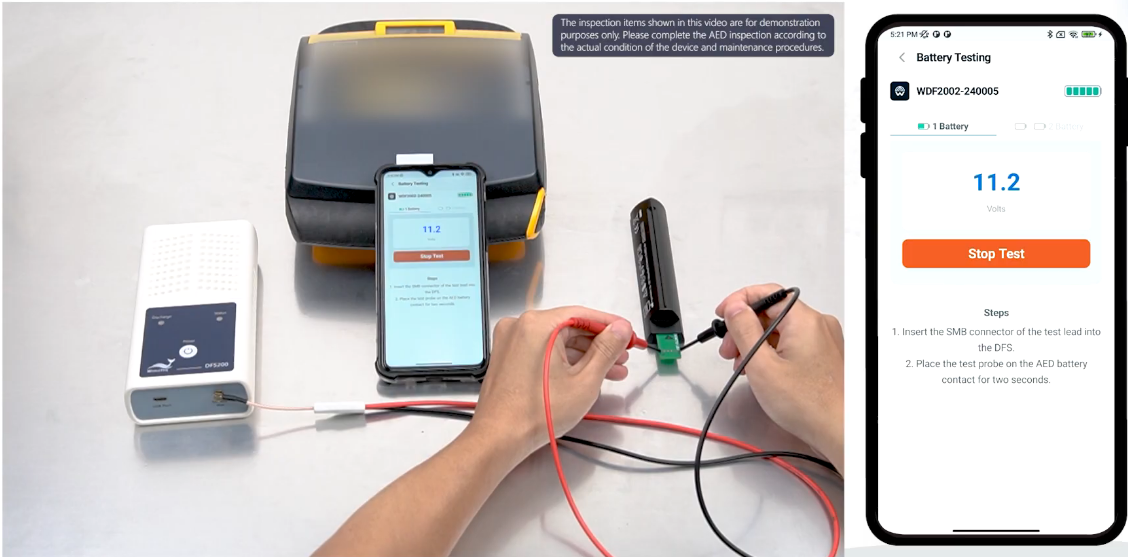
DFS200 can be used to measure AED shock energy and battery voltage, allowing service personnel to verify actual device performance after completing the visual inspection.
This is why a complete AED maintenance process should not rely solely on visual checks or the device’s self-test status. External measurement provides an additional level of verification for actual performance.
*Testing product in use: DFS200 | Defibrillator / AED Handheld Tester
Figure 2. Using DFS200 to measure AED shock energy. The App displays the discharge waveform and measured energy in joules during the test.
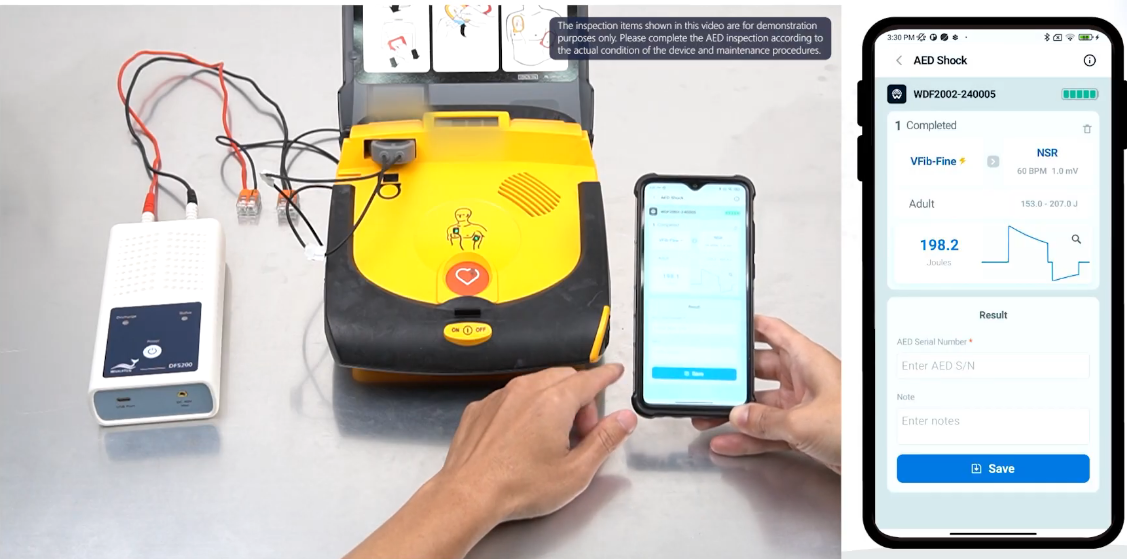
Figure 3. Using DFS200 to measure AED battery voltage. Measurement results are displayed in the App in real time.
3. Capture Inspection and Test Results as Maintenance Data
A single AED maintenance visit can generate multiple types of information, including:
-
Device and customer information
-
Visual inspection results
-
Battery and consumable status
-
AED shock test results
-
Battery voltage measurements
-
Maintenance date and service personnel
-
Field notes and observations
When this information is recorded using separate tools, field personnel may first complete an inspection form, then organize the measurement results separately, and later enter the same information again into another system after returning to the office.
The purpose of the DFS200 App is to bring inspection information and measurement data into the same workflow.
Once the on-site inspection and testing are complete, the collected information can form a more complete maintenance record that can be used for reporting or internal management.
In other words, maintenance data does not need to be recreated at every stage. Once captured in the field, it can continue to support the next step in the process.
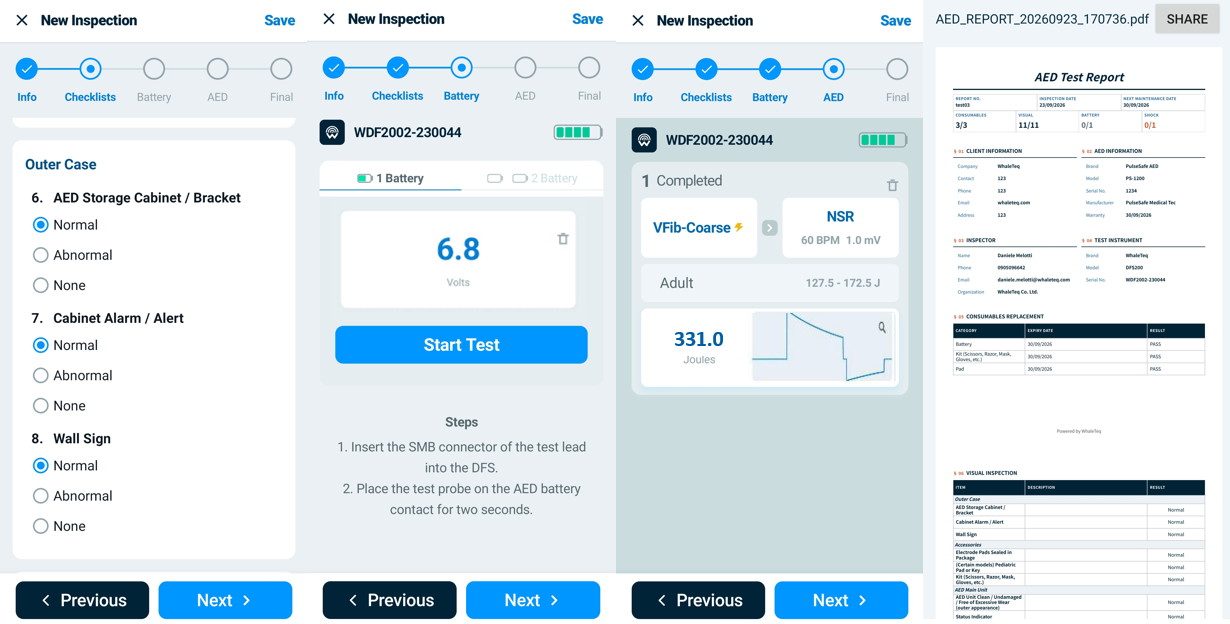
Figure 4. The DFS200 App integrates inspection, testing, and report generation into a single workflow.
4. Choose How to Use the Maintenance Data
Different service teams may have different requirements once an AED inspection is completed.
For this reason, there is no single way that maintenance data must be used.
Option 1: Generate a Maintenance Report Directly On Site
For service teams that do not use a centralized management system, or whose primary requirement is to complete on-site service and provide a maintenance record to the customer, the inspection and measurement data can be used directly to generate a maintenance report.
The workflow can be simplified as:
Inspection and testing → Maintenance data → Report generation → Customer delivery or record retention
This approach is suitable for teams that need to complete individual maintenance jobs efficiently and provide documentation immediately after service.
The value of report generation is not simply the creation of a PDF file. It also reduces the need for service personnel to reorganize information that has already been entered during the inspection and test process.
Option 2: Synchronize Data with a Central Management System
Organizations that manage large numbers of AEDs, operate across multiple service regions, or already use an internal asset or maintenance management system may have different requirements.
In these cases, inspection data may need to be sent back to headquarters or transferred into an existing enterprise system, where maintenance records and reports can be managed centrally.
The workflow becomes:
Inspection and testing → Maintenance data → Data synchronization → Existing enterprise system → Centralized management and reporting
This allows headquarters to generate reports according to a standardized corporate format, reducing inconsistencies that can occur when individual service personnel prepare documents independently.
It also makes it easier to maintain consistent and traceable maintenance records.
For larger organizations, this is not only a matter of efficiency. It is also part of their responsibility for managing device safety.
Organizations need visibility into which AEDs have been inspected, when the inspection was performed, what the actual measurement results were, and whether any issues require follow-up.
The value of data synchronization therefore goes beyond eliminating duplicate data entry. It allows information collected in the field to become part of the organization’s existing management process.
From AED Testing to a More Complete Maintenance Workflow
For AED service teams, the goal is not simply to add more functions. What matters is ensuring that every necessary maintenance step can be performed, documented, and used effectively according to the organization’s needs.
From defining inspection items and performing visual checks to instrument-based testing, maintenance data capture, report generation, and system integration, DFS200 brings previously disconnected tasks into a more connected maintenance workflow.
By combining AED inspection, functional testing, and maintenance data management, DFS200 helps service teams build a more efficient and flexible after-sales maintenance process.